


By: Zaenal Abidin
“No one is left behind, including our friends with disabilities.” This simple statement was uttered by Alifatul Arifiati, opening the training session titled Strengthening the Rights of Persons with Disabilities for Female Clerics on Friday, June 13, 2025. The statement sounded like a collective wake-up call: that the struggle of female religious scholars cannot be separated from defending those who are most vulnerable.
Held online, this training was the first of three sessions designed by the Fahmina Foundation in collaboration with the Indonesian Female Clerics Congress (KUPI) Youth Network. Participants came from five regions: Cirebon, Semarang, Malang, Yogyakarta, and surrounding areas—including female Islamic boarding school teachers, academics, religious counselors, and parents of children with disabilities.
Tawassul, Pledge, and Commitment
The event opened with tawassul led by Mrs. Rindang Farihah, followed by the reading of the KUPI Youth Network Pledge by Nyai Siti Rofiah from Jepara. In the pledge, the young female scholars affirmed their commitment to defend the marginalized and reject extremism that disrupts national harmony.
“Female scholars are those who have the awareness to serve fairly,” said Alifatul. “They don’t have to be on the podium, on campus, or in a large Islamic boarding school. But anyone who speaks up and acts for the common good is a scholar.”
Recognizing Limitations, Strengthening Dignity
In her speech, Rozikoh M.Pd from the Fahmina Foundation emphasized that people with disabilities are an integral part of society. However, reality shows that there are still many obstacles that prevent their full participation, including in religious spaces.
“BPS data shows that 8.5 percent of Indonesia’s population are people with disabilities. However, places of worship, Islamic boarding schools, and madrasas are not yet disability-friendly,” said Rozikoh. “This is where the involvement of female scholars is important to create inclusive spaces of worship.”
Shifting Perspectives: From the Fought For to the Fighters
Kiai Faqih Abdul Kodir, advisor to the Fahmina Foundation and one of the intellectual driving forces behind KUPI, invited participants to reflect more deeply: that every human being is, in essence, a weak creature. “We all have a disabled side,” said Faqih. “But those who do not yet have a space in society and religion must be given authority.”
Kiai Faqih highlighted that, until now, disability jurisprudence has been dominated by narratives from non-disabled people. “Just as women’s experiences gave birth to KUPI’s awareness, we also need disability jurisprudence that is born from the direct experiences of disabled people themselves.”
According to him, female scholars can serve as bridges and provide a platform for those who have been neglected.
From the Field to the Advocacy Stage
Various figures and practitioners attended this training, including Tutik Hamidah (UIN Malang), Rasyidah (PP Al Hayat Malang), Rohmani Nur Indah (UIN Malang, also the mother of two children with intellectual disabilities), Wiwin Rohmawati and Rindang Farihah from Yogyakarta, as well as activists from Sahabat Tuli (Friends of the Deaf) from Salatiga.
Widi Utami from Sahabat Tuli Salatiga, for example, conveyed how access to worship for people with disabilities has been minimal. “I cannot hear, but I am grateful that today there is a religious movement that sees us,” she said.
From Cirebon, academics and activists such as Asih Widyowati (Umah Ramah and ISIF), Amelia Handayani (UIN SSC), as well as religious counselors and pesantren teachers were also present.
Breaking Down Narratives, Building Access
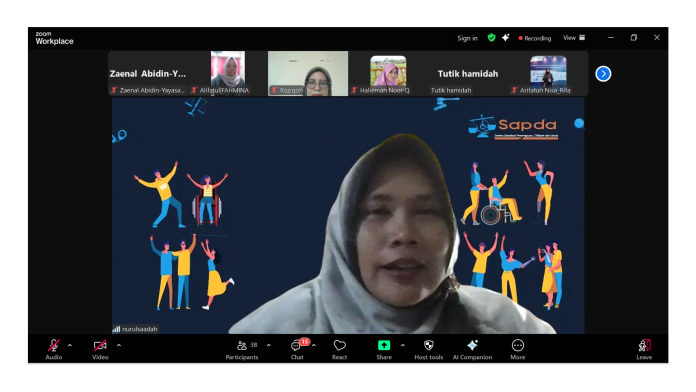
The training was facilitated by Nurul Saadah Andriani, a Master of Law from UGM, who is also a woman with a disability. “I have mobility issues and use a cane,” she said. “But I am a mother, a legal assistant, and a policy writer.”
For more than two decades, Nurul has been active in drafting inclusive regulations, ranging from court access design for persons with disabilities to health policies. In her first session, she invited participants to understand disability as a social construct and the importance of distinguishing between biological ‘deficiencies’ and social barriers produced by the environment.
“Discussions like this need to continue,” Nurul emphasized. “Not just so that people with disabilities are heard, but so that they can help shape the system and develop their own jurisprudence.”
From Awareness to Movement
This training is not the end, but the beginning. In the next two meetings, participants will explore further experiences, fiqh approaches, and local advocacy strategies. In the future, it is hoped that inclusive religious teaching modules and district forums that protect the rights of persons with disabilities will be created.
As Kiai Faqih stated, “KUPI is not just a space for women, but also for those who have not yet had a complete space. We must all become bridges of justice, honoring those who have been marginalized,” he said. []

